Rebalance Process Flow
How the protocol restores collateral ratio by burning ha from stability pools and paying out rebalance tokens to those pools.
Contract SoT: Stability pool manager. Pool behaviour: Stability pools process flow.
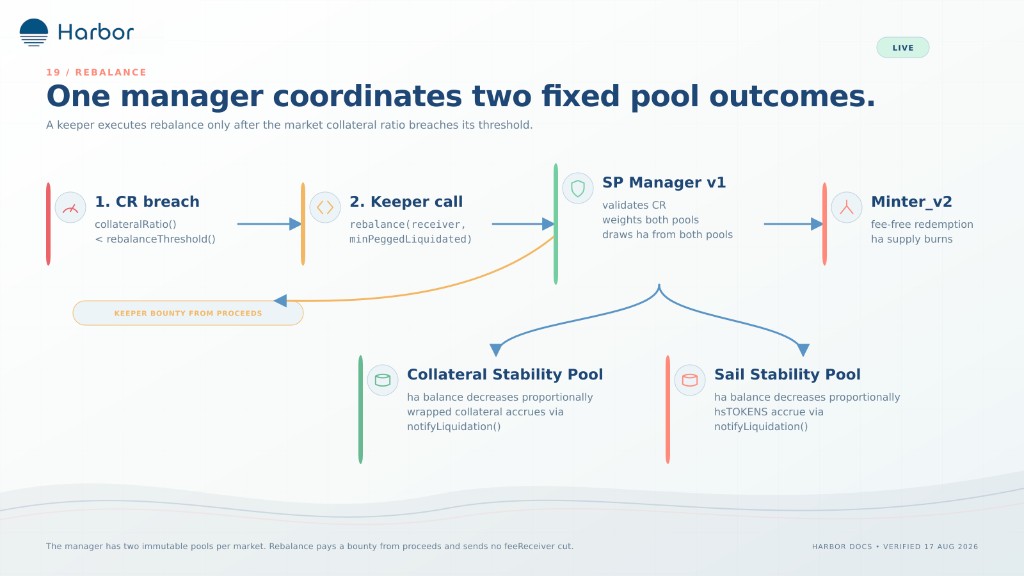
Trigger
Rebalancing is allowed when the minter’s collateral ratio is below the manager’s rebalanceThreshold (view: rebalanceable()).
collateralRatio = collateralValue / peggedValue; // via Minter
if (collateralRatio < rebalanceThreshold) {
    // rebalance() may be called
}
Anyone can call it when eligible; keepers typically do for the bounty.
Process
1. Call
stabilityPoolManager.rebalance(bountyReceiver, minPeggedLiquidated);
- Checks CR is below the rebalance threshold (reverts otherwise).
minPeggedLiquidatedis a slippage / minimum burn guard (not a “max rebalance” circuit breaker).- The explicitly supplied
bountyReceiverreceives a rebalance bounty cut of the payout tokens (configuredrebalanceBountyRatio) — not necessarilymsg.sender.
2. Burn ha from pools
- Manager pulls ha from the collateral and Sail stability pools (fee-free path via
ZERO_FEE_ROLE). - ha is redeemed through the minter (
freeRedeemPeggedToken) so system pegged supply falls and CR rises. - Each pool’s ha balances scale down via the loss product.
3. Pay out rebalance tokens
| Pool | Payout token |
|---|---|
| Collateral stability pool | Wrapped collateral (e.g. fxSAVE, wstETH) |
| Sail stability pool | hs (leveraged) |
After the bounty to bountyReceiver, remaining wrapped collateral / hs is transferred to the pools and attributed via notifyLiquidation / reward deposit paths. Depositors accrue them as claimable rewards — they do not auto-mint into the user’s ha balance. Claim with claim() / claimable.
4. Bounty only (no feeReceiver cut on rebalance)
Rebalance pays the configured bounty to bountyReceiver. Protocol feeReceiver cuts apply on harvest, not on this rebalance path.
Illustrative example
- System CR drops below threshold (e.g. 130% → 120%).
- Keeper calls
rebalance(keeper, minPeggedLiquidated)(or anybountyReceiver). - ha is taken from both pools and redeemed via the minter.
- Bounty tokens go to
bountyReceiver; remaining wrapped collateral / hs return to the pools. - Collateral pool depositors can later claim wrapped collateral; Sail depositors can claim hs — proportional to pool accounting.
What this is not
Do not assume these (not in the live SPM):
- Rebalance queues or priority lanes
- Gas reimbursement beyond the bounty
- Circuit breakers / pause beyond normal access control
- A separate “maximum rebalance size” parameter (sizing is whatever the pools can provide under the CR math +
minPeggedLiquidated)
Depositor takeaways
- Know which pool you are in (collateral vs Sail) — payout token differs.
- Monitor CR /
rebalanceable(). - After a rebalance, claim reward tokens; ha balance may be lower due to the loss product.