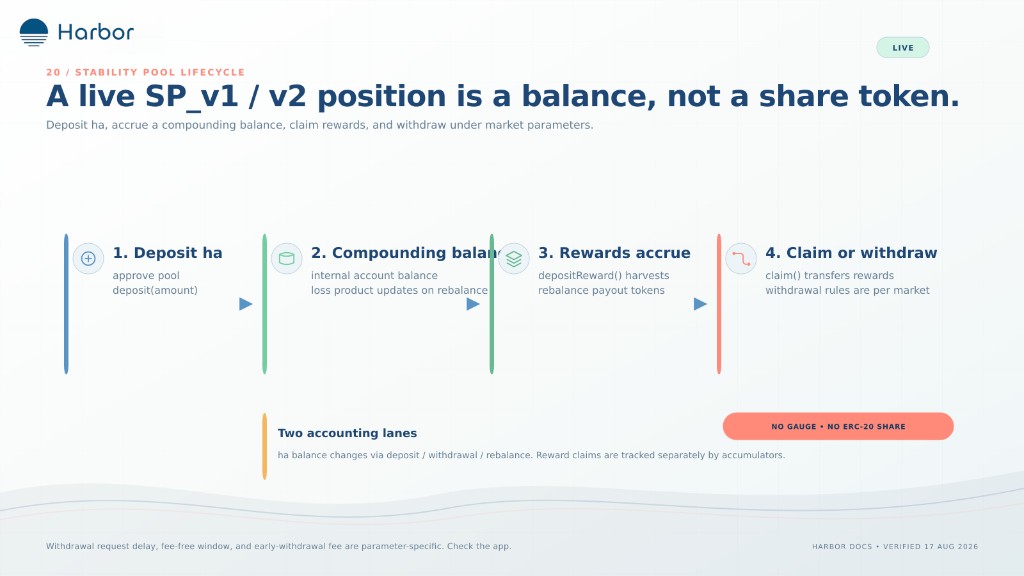
Stability Pools Process Flow

This document describes how stability pools work, including deposits, withdrawals, rewards, and rebalancing.

Overview

Stability pools provide a mechanism for users to earn yield while providing liquidity for protocol rebalancing. Depositors receive rewards and rebalance tokens (collateral or leveraged tokens) in exchange for their deposits.

Deposit Process

Step-by-Step Flow

  1. User Initiates Deposit

    • User calls deposit(amount) on Stability Pool contract
    • Provides asset tokens (pegged tokens, e.g., haETH)
  2. Token Transfer

    • Asset tokens are transferred from user to stability pool
    • Pool balance increases
  3. Stake Token Minting

    • LP tokens (stake tokens) are minted to user
    • Amount minted = (deposit amount × total stake tokens) / total assets
    • Represents user's share of the pool
  4. Gauge Staking

    • Stake tokens are automatically staked in the liquidity gauge
    • User becomes eligible for rewards
  5. Event Emission

    • Deposited event emitted with user address and amount

Example

Pool State:
- Total Assets: 1000 haETH
- Total Stake Tokens: 1000

User deposits 100 haETH:
- New Total Assets: 1100 haETH
- Stake Tokens Minted: (100 × 1000) / 1000 = 100
- User receives 100 stake tokens

Withdrawal Process

Step-by-Step Flow

  1. User Initiates Withdrawal

    • User calls withdraw(amount) on Stability Pool
    • Specifies amount of stake tokens to burn
  2. Stake Token Validation

    • Contract verifies user has sufficient stake tokens
    • Checks if withdrawal is allowed (no active liquidations, etc.)
  3. Asset Calculation

    • Assets to return = (stake tokens × total assets) / total stake tokens
    • Accounts for any accrued value from liquidations
  4. Token Transfer

    • Asset tokens transferred from pool to user
    • Stake tokens burned
  5. Gauge Unstaking

    • Stake tokens unstaked from gauge
    • Rewards remain claimable
  6. Event Emission

    • Withdrawn event emitted

Example

Pool State:
- Total Assets: 1100 haETH (includes liquidation gains)
- Total Stake Tokens: 1100

User withdraws 100 stake tokens:
- Assets Returned: (100 × 1100) / 1100 = 100 haETH
- But pool may have gained value from liquidations
- User receives proportional share of gains

Reward Mechanism

Compounding Accumulator System

Stability pools use a compounding accumulator system for reward distribution:

  1. Reward Tokens: Multiple tokens supported (e.g., TIDE, wstETH from harvests)
  2. Distribution: Based on user's share of total pool balance
  3. Compounding: Rewards compound automatically into user balances

Reward Calculation

Rewards are calculated using an integral-based system:

  • Global reward integrals track accumulated rewards per token
  • User checkpoints track their position in the reward accumulation
  • Rewards = (userShare × (currentIntegral - userCheckpointIntegral)) / precision

Claiming Rewards

  1. User Calls claim()

    • Checkpoints user to update reward calculations
    • Calculates accrued rewards for all active reward tokens
    • Transfers reward tokens to user (or custom receiver)
  2. Reward Updates

    • User's reward snapshot updated
    • Pending rewards reset to zero
    • Claimed amount incremented
    • Event emitted

For detailed information about the reward system, see Reward System Contracts.

Rebalance Participation

How Depositors Benefit

When rebalancing occurs:

  1. Rebalance Tokens Received

    • Depositors receive rebalance tokens (collateral or leveraged tokens)
    • Proportional to their stake in the pool
  2. Value Accrual

    • Pool's total asset value may increase
    • Stake token holders benefit from rebalance gains
    • Value per stake token increases
  3. Diversification

    • Depositors gain exposure to rebalance tokens
    • Can hold or sell rebalance tokens

Rebalance Flow Integration

Rebalancing occurs:

Pegged tokens burned from pools

Rebalance tokens distributed to pools

Pool's rebalance token balance increases

Value per stake token increases

Depositors benefit when withdrawing

Pool Types Comparison

Collateral Stability Pool

Characteristics:

  • Liquidation Token: wstETH (collateral)
  • Risk Profile: Lower risk, stable collateral
  • Use Case: Conservative yield earning

Rewards:

  • TIDE token rewards
  • wstETH from rebalancing
  • Staking yield from underlying collateral

Sail Stability Pool

Characteristics:

  • Liquidation Token: Leveraged tokens (hsETHxFxSAVE)
  • Risk Profile: Higher risk, leveraged exposure
  • Use Case: Aggressive yield + exposure

Rewards:

  • TIDE token rewards
  • Leveraged tokens from rebalancing
  • Potential for leveraged gains

Pool State Management

Key Metrics

  • Total Assets: Total asset tokens in pool
  • Total Stake Tokens: Total LP tokens minted
  • Rebalance Token Balance: Accumulated rebalance tokens
  • Reward Accumulation: Accrued rewards from multiple tokens

State Updates

  • Deposits increase both assets and stake tokens
  • Withdrawals decrease both proportionally
  • Rebalancing increases rebalance token balance
  • Rewards accrue continuously via gauge

Risk Considerations

For Depositors

  • Impermanent Loss: Value changes from rebalancing
  • Rebalance Token Risk: Value of received tokens may fluctuate
  • Smart Contract Risk: Protocol and contract risks
  • Reward Volatility: Reward token price fluctuations

Mitigations

  • Diversification across pool types
  • Monitoring pool health metrics
  • Understanding rebalancing mechanics

Best Practices

  1. Diversify: Consider both pool types
  2. Monitor: Track pool metrics and health
  3. Timing: Consider market conditions for deposits/withdrawals
  4. Understand: Know what rebalance tokens you'll receive