How Yield is Generated
Harbor’s high yields come from concentrating collateral yield and protocol revenue into stability pool depositors. Deposit ha in Earn. Terms: Glossary.
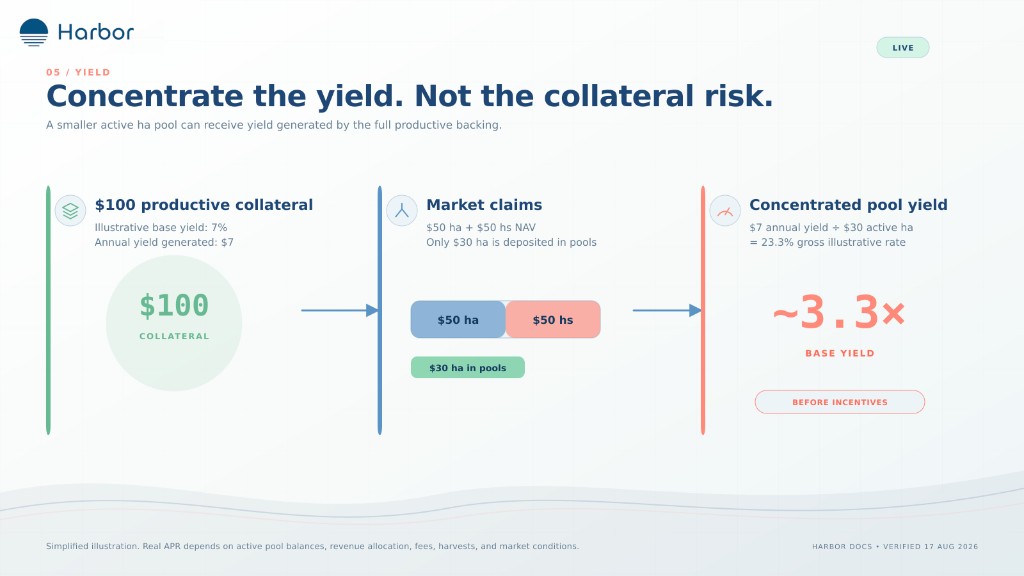
Yield concentration
When you mint ha and hs, collateral sits in a shared pool. Only ha deposited in a stability pool (collateral or Sail) earns that concentrated yield. Pool types share harvest / revenue to pools; they differ in rebalance payout (collateral vs hs), Stability Pools.
Example: $100 collateral backs $50 ha and $50 hs. If only $30 ha sits in the pool, that $30 earns yield attributed to the full $100 backing, roughly ~3× the base collateral APR before incentives (e.g. 7% collateral → ~20%+ pool APR illustrative).
Protocol revenue
Revenue = collateral yield + mint/redeem fees. Per market:
- Up to ~5% → Maiden Voyage Yield Share (when eligible)
- Remainder → any post–$10M TVL treasury take → 75% stability pools / 25% buy TIDE
Diagram: TIDE Tokenomics.
Who earns what
- ha in a stability pool: high APR vs collateral alone + pool revenue share
- hs: benefits from rebalancing / risk role; does not earn concentrated collateral yield directly
Marks and TIDE campaigns can boost effective returns where allocated.
Mid-term - Harbor Yield
Three participation levels (siblings, not a wrapping stack, levels 2 and 3 do not wrap each other): (1) pool + manual claim live; (2) Compounder; (3) hyTOKEN basket. See Harbor Yield (levels 2–3 not live mainnet yet).
By concentrating collateral yield into pools, and sending 75% of (post–Yield Share / post–TVL-take) revenue to pools, Harbor targets strong APRs for users who secure the protocol in Earn.