How It Works
What happens to your money in Harbor, without CDP jargon first. For NAV, collateral ratios, and fee math, see Technical Overview. Terms: Glossary.
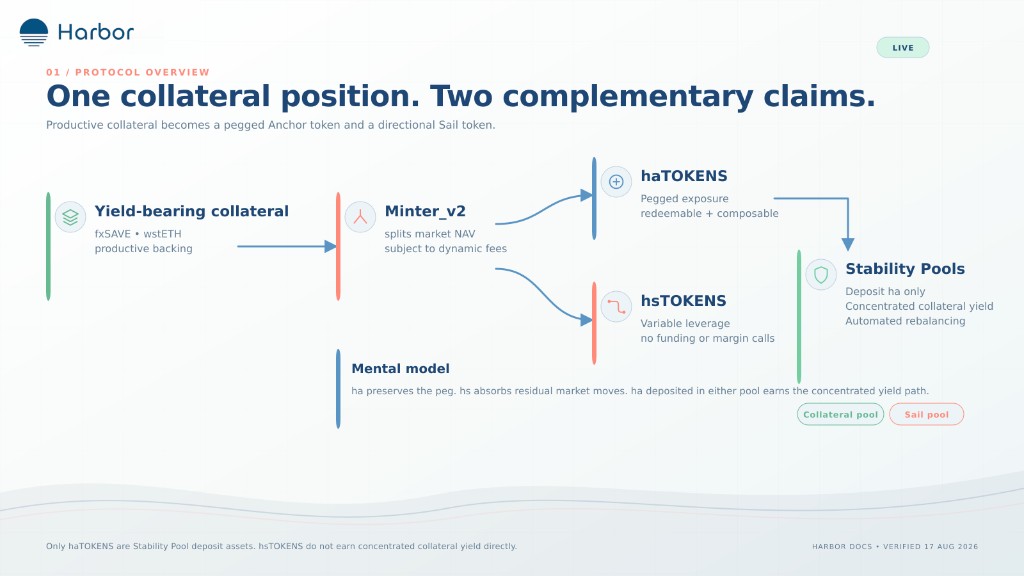
The 60-second version
- You deposit productive collateral: usually fxSAVE (fxUSD markets) or wstETH (stETH markets).
- The market mints two tokens from that shared pool:
- ha: pegged to something you chose (ETH, BTC, EUR, …)
- hs: the leftover leverage side (absorbs volatility first)
- To earn yield, deposit ha into a stability pool in the app’s Earn section.
- If the market gets stressed, pools rebalance: your deposited ha may be swapped for collateral or hs, depending on which pool you picked.
That’s the live product on Ethereum today.
Step by step
1. Deposit collateral
Connect at app.harborfinance.io. Pick a market (see Live Markets).
- fxSAVE markets: collateral earns f(x) yield; you can zap from fxUSD if convenient.
- wstETH markets: collateral earns staking yield; you can zap from ETH/stETH if convenient.
Prefer holding the market’s main collateral (fxSAVE or wstETH) when you can. Zaps are shortcuts, not the core design. See Supporting Features.
2. Mint ha and/or hs
- ha behaves like a pegged asset (haETH tracks ETH, haBTC tracks BTC, …).
- hs behaves like variable leverage on collateral vs that peg: no funding fee, no leverage slider, no stop-loss ticket.
You can hold either or both. Only ha goes into stability pools.
3. Earn - stability pools
In Earn, deposit ha into one of two pool types:
| Pool type | You earn | If a rebalance uses your deposit |
|---|---|---|
| Collateral pool | Concentrated collateral yield + pool revenue share | You receive collateral (e.g. fxSAVE, wstETH) at oracle value |
| Sail pool | Same yield path as collateral pool | You receive hs instead |
Both pools earn yield on the ha deposit. The difference is what you get if a rebalance burns your ha.
Read Stability Pools and How Yield is Generated.
4. Leverage - hold or mint hs
Use Leverage to mint or manage hs. hs can gain or lose value quickly. In extreme stress, hs can approach zero while ha may trade below peg. See Risk Considerations.
5. Maiden Voyage - new markets
Maiden Voyage bootstraps markets before or at launch: capped deposits, then claim ha and hs when the market goes live. Eligible participants may receive ongoing Yield Share. See Maiden Voyage.
What you should expect
- Yield: from collateral yield and protocol revenue concentrated into pool depositors (not from hs directly).
- Fees: mint/redeem fees move with system stress; see Protocol Fees.
- Withdrawals: pools may use a request window; early exit can cost extra, check the app.
- Rebalances: normal in stress; not the same as a perp liquidation, but you can end up with different assets than you deposited.
Where to go next
| Goal | Start here |
|---|---|
| I have ETH and want yield | Get Started |
| Compare live markets | Live Markets |
| Deeper mechanics | Technical Overview |
| Risks in plain English | Risk Considerations |