Pricing
Harbor exposes several price surfaces. They are not interchangeable. ha/hs ERC-20s are mint/burn tokens — do not assume they implement Chainlink latestRoundData or a token price() unless you have verified the bytecode.
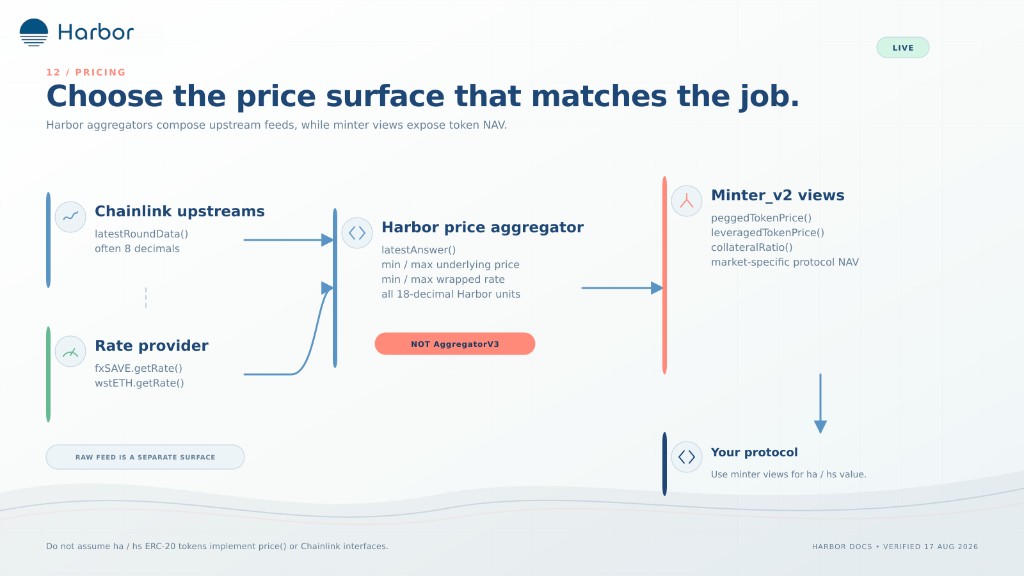
Which function to call
| Need | Call | Units | Notes |
|---|---|---|---|
| ha (pegged) value in collateral / protocol NAV | Minter peggedTokenPrice() | 18 decimals (1e18 = 1.0) | Market-specific minter |
| hs (Sail) NAV | Minter leveragedTokenPrice() | 18 decimals | Residual claim; moves with CR and collateral |
| Wrap rate + underlying used by the minter | Harbor aggregator latestAnswer() | Four uint256s, 18 decimals | Not AggregatorV3 |
| Raw Chainlink (ETH/USD, BTC/USD, …) | Chainlink proxy latestRoundData() | Often 8 decimals | Harbor aggregators already compose these |
Token ERC-20 price() | — | — | Not a documented Harbor ha/hs API. Use minter views. |
Aggregator signature (Harbor):
function latestAnswer()
    external
    view
    returns (
        uint256 minUnderlyingPrice,
        uint256 maxUnderlyingPrice,
        uint256 minWrappedRate,
        uint256 maxWrappedRate
    );
Today min and max are typically equal (bounds reserved). Wrapped rate is fxSAVE / wstETH (etc.) vs underlying, validated by ChainlinkRateLib (default 0.9–3.0×; out of range → InvalidRate). Full behaviour: Price oracle contracts.
Minter views: Minter (peggedTokenPrice, leveragedTokenPrice, collateralRatio).
Worked example 1 — fxUSD / ETH (single feed + rate)
Market: haETH / fxUSD. Oracle detail: fxUSD/ETH.
Composition (conceptual):
rate = fxSAVE.getRate()(fxUSD per fxSAVE, 18 decimals via Harbor rate lib).- Chainlink ETH/USD, inverted → USD/ETH, scaled to 18 decimals.
- Aggregator returns
(price, price, rate, rate)as fxUSD/ETH-style inputs the minter consumes.
Sample eth_call (aggregator):
to: <market priceOracle from the market page>
data: latestAnswer()   // 0x50d25bcd
Decode four uint256s. Convert with formatUnits(x, 18).
Solidity (read-only):
interface IHarborAggregator {
    function latestAnswer()
        external
        view
        returns (uint256, uint256, uint256, uint256);
}

function wrappedValueHint(address oracle, uint256 wrappedAmount)
    external
    view
    returns (uint256 minUnderlyingPrice, uint256 minWrappedRate)
{
    (minUnderlyingPrice, , minWrappedRate, ) = IHarborAggregator(oracle).latestAnswer();
    // wrappedAmount * minWrappedRate / 1e18  → underlying units (then * price as needed)
}
Prefer the market-wired oracle address on the market page if it differs from the inventory alias.
Worked example 2 — stETH / BTC (double feed + wstETH rate)
Market: haBTC / stETH. Oracle: stETH/BTC.
Composition (conceptual):
rate = wstETH.getRate()(stETH per wstETH).price ≈ (ETH/USD) / (BTC/USD)(both Chainlink), optional divisor / invert as configured.- Result is stETH/BTC-style pricing for the minter.
Same latestAnswer() ABI. Do not pass Harbor aggregator addresses into code that expects AggregatorV3.
Worked example 3 — hs leverage NAV feed
Inventory example: hs fxUSD (haBTC) — type leverage, no collateral rate provider.
These feeds estimate USD-denominated Sail NAV for listings / wrappers. For protocol mint/redeem accounting, use the market minter leveragedTokenPrice(), not a standalone leverage oracle, unless you are explicitly consuming that inventory feed.
Chainlink vs Harbor
Harbor aggregators already combine Chainlink feeds + rate providers + heartbeat/staleness checks. Integrators who need a Chainlink-shaped latestRoundData / 8-decimal price() should use a wrapper adapter once deployed — Oracle adapters (spec only today).
Related
- Inventories: Mainnet oracles
- Product: Supporting features