Zaps
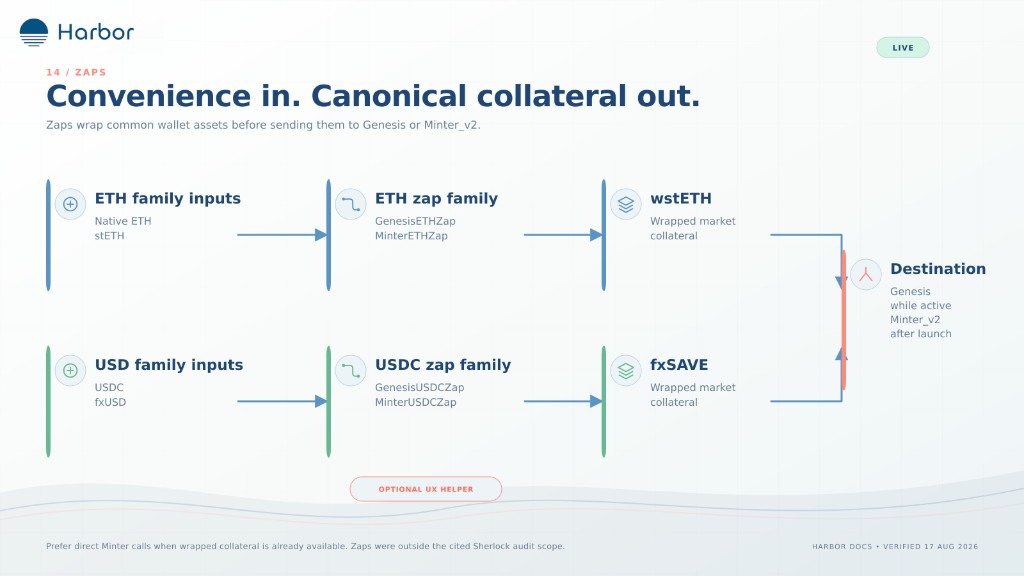
Zaps wrap ETH / stETH / USDC / fxUSD into the market’s wrapped collateral, then deposit into Genesis or the Minter. They are convenience only — prefer calling the minter with wrapped collateral when you already hold it. See Mint and redeem.
Full address table: Zap contracts. Per-market rows: genesisZap, peggedTokenZap, leveragedTokenZap on each market page.
When to use them
| Use zap | Use minter directly |
|---|---|
| User wallet has native ETH, stETH, USDC, or fxUSD | Your protocol already holds fxSAVE / wstETH (or that market’s wrapped collateral) |
| Maiden Voyage deposits (genesis still open) | Production mint/redeem of ha/hs with known wrapped balances |
| App-style one-click UX | Fewer contracts, no zap upgrade surface |
Zaps are out of Sherlock audit scope (see FAQ). Treat them as optional helpers.
Families
| Family | Typical inputs | Destination |
|---|---|---|
| GenesisETHZap | ETH, stETH (permit where supported) | Market genesis |
| MinterETHZap | ETH, stETH | Mint ha / hs (and some stability-pool paths) |
| GenesisUSDCZap | USDC, fxUSD | Genesis |
| MinterUSDCZap | USDC, fxUSD | Mint ha / hs |
Versions differ by market (v1 CREATE3 on haUSD/stETH; v2–v4 elsewhere). Always use the proxy on the market page.
ETH-family entrypoints commonly include zapNativeAsset, zapCollateral, and zapCollateralWithPermit (stETH has EIP-2612). Confirm the ABI on the zap implementation behind that proxy — harbor-zap-contracts.
Integrator path
- Read
genesisZap/peggedTokenZap/leveragedTokenZapfrom the market page (or app config). Empty / “none” means no zap — deposit wrapped collateral. - Approve the input token to the zap (except native ETH
msg.valuepaths). - Set slippage / min-out per leg. Prefer a zap-specific preview. If the zap exposes none, use the minter
*DryRunfor the minter leg only (after converting to wrapped units), and set a separate conservative minimum for the wrap leg — see SDK helpers. - Pegged and leveraged minter zaps are often the same contract (
peggedTokenZap=leveragedTokenZap).
SDK helpers
@harbor/sdk encodeZap.* builds calldata for common genesis / minter paths once the market lists zap addresses. Do not treat a minter *DryRun alone as the zap’s end-to-end preview: prefer a zap-specific preview when the zap exposes one; otherwise set a conservative lower bound and separate minimums for the zap wrap leg and the minter leg (minWrappedCollateralOut / minTokenOut).